It is now three years since this website reviewed Chilean masters of chamber rock, Asceta, and their Erebus, which you can view by clicking on the button below:
Come 2026, and available via Lizard Records Italy http://www.lizardrecords.it/asceta-the-fool-leading-the-blind/ we have The Fool Leading the Blind, and it is a treat for the ears. All tracks are composed by the maestro, Rodrigo Maccioni, and with a statement of artistic intent, it all kicks off with 21-minute epic, so yet another contender for this year’s “Topographic Oceans” award, fast becoming a rather crowded field, I must say.
There is a concept in this instrumental delight (and very apposite for the world we are living in), the willingness of people to follow egotists and narcissists who promise the earth, but are, in reality, engaging in populist deception.
We witness a massive amount of energy on display here, musicianship of the highest order, and an understanding that its target audience wants to be engaged, to explore, not to be comforted by the easy options. I admire that a great deal.
So, five pieces of music to consider. Firstly, we do have a trailer video from the record label, and that is embedded below.
So, that huge epic piece, the title track. There is a sense of malice to start, Alejandro Vera’s bassoon weaving like a political snake amongst the proletariat, gauging the mood, all the while scheming as to how to make his move, the cello of Cristián Peralta mournful, the people desperate for succour, whilst Maccioni produces some delicate electric guitar touches.
Of course, with a track this length, the narrative is given a huge amount of space with which to develop, so no sudden flashes, explosions of noise, but a steady beat of music, at times dancing along, at others pensive, but never anything less than fascinating, this subtle blend of the classical and rock, woodwind and electric piano sizing each other up in preparation for the despot’s move to gain traction, a jazz-infused story of itself, and the rhythm section of Eduardo Rubio on bass and Leonardo Saavedra on drums and percussion are vital to the fusion sensibility, underpinning the entire ensemble, the electric piano pulsing a dystopian despair at established political processes allowing the populist narrative to take precedence, persuading the masses that only this can change things for the better, with some forceful guitar riffs and enticing clarinet (come with me, for I will set you free) making this point firmly, all the while the weaving under the surface cleverly continuing, the gorgeous bass melody solidifying the masses wish to follow the Pied Piper, the mood becoming chaotic as we move to the close of the piece, the revolution in front of our eyes, deceptive mission on the verge of accomplishment, and the band really rock out here until the final seconds bring us a wistful close.
Throughout this impressive epic, the instruments talk to each other, dance a loop, set scenes, in a perfect classical fusion blend. It is deeply impressive, intelligent music for the ages.
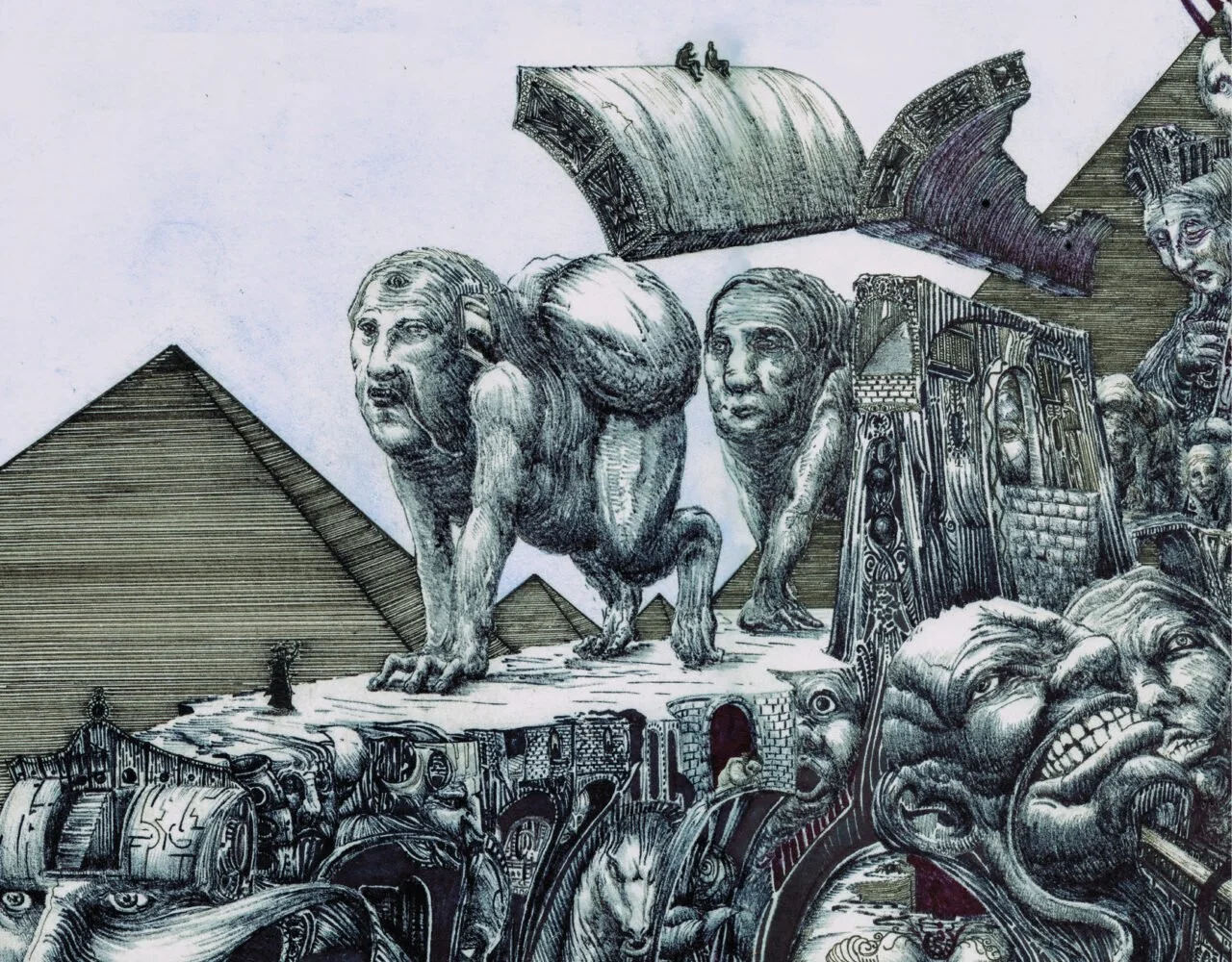
Temple of Mirrors follows this. It has a spartan opening, strange effects unnerving the listener, reflections of oneself beaming outwards and forced in upon us. The band have an official video for this, and it is a great opportunity for you to see the incredible visual art which accompanies this work. The guitar riffs are sublime, with the ensemble almost teasing us with “three blind mice”, humans as small objects before mighty spectacles and fools with power, the tools of that power exemplified by the thudding notes, the cello and ghostly electric guitar telling us of regret at our folly.
When They Arrive is next. The cello increases the drama, whilst Jorge Bugueño on his electric piano plays off Maccioni on the guitar, Saavedra pulling off a percussion highlight of the year to me, deceptively simple notes utilised to great effect, and as we progress, the whole piece becomes more urgent, some piercing notes hitting the air, processional, and experimental music lovers will note the interesting effects. As we move to the close, the guitar solo is gorgeously sad, the cello the perfect accompaniment, the electric piano reminding one of Rick Davies plinking back in the day.
The penultimate piece is Everything Stopped, and we have another video for you. The use of reverb is noted on this, and Arianne Guerra produces some fine bursts on the viola, but, in the main, this is a quieter track than the rest of the album, stripped-back, the witnesses to the horror they have allowed taking time to reflect and, perhaps, ponder as to how this can be reversed, the clarinet and bassoon almost conspiratorial in their playing, some fine rhythm section work again, and a guitar riff which takes me all the way back to Fripp and Red.
We close with Momento Mori (Remember That You Will Die) – a motif reminding us that death is inevitable, Stoics curbing the populations pleasures, the philosophy growing into modern understanding of the nature of heaven and hell, the soul being capable of redemption. This is another epic piece, just over ten minutes, so fans of the longer form have plenty to enjoy on this album. The ghostly guitar returns here, and Maccioni clearly admires Steve Hackett’s early work with Genesis, because you do hear shades of that genius throughout this album. In Roman times, a general celebrating a Triumph would have a slave sitting behind him in the chariot whispering in his ear. “remember you are mortal”, lest he became overexcited and consider himself on a par with the gods, whose jealously would be aroused, and here I picture that procession, pulsing notes ringing the cheers of the crowd, the piano exuding the circus performers, the guitar the triumphant populist at the apex of his political and military career, the clarinet, though, attempting to bring him back to earth. It didn’t really succeed, the hubris of leaders never reined back, here the racing tempo the final subjugation of the people, with some more disturbing effects witnessed, the mournful bassoon, bass, viola, and percussion the people looking on at giants over them, bodies and buildings, everything now designed to bring to them a sense of proportion over the futility of their lives, the rock beat progressively louder as we move to the end, those in control thoroughly dominant.
This is another fine effort from Asceta, an album which demands attention and time, and when you are willing to do so, brings so much pleasure and wonder at a group of musicians at the top of their game.
Very highly recommended for those of you who might want to move beyond the recent BBC Prog Prom to hear the fusion of classics and rock in a modern setting.
STOP PRESS - now available on Bandcamp! https://asceta-ensemble.bandcamp.com/album/the-fool-leading-the-blind