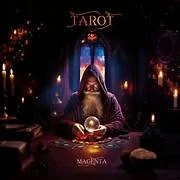
There was an interesting exchange on the Prog Archives forum recently about Magenta, and the view which caught my eye was that, rightly, expressing bemusement at how the band could possibly be categorised as “neo-prog” there, given that a more natural successor to the tradition of Renaissance, Yes, and the outsized instrumental genius of Mike Oldfield would be hard to find. Oh well, they must listen to things differently in deepest Peru.
Since being formed in South Wales 25 years ago, the band have consistently delighted the progressive world with quality albums, musically as tight as they come, telling stories in an intelligent manner, and putting their own stamp upon influences I set out above.
Tarot is their tenth original studio album, and I agree with the comments made by Robert Reed in his interview with me (click on the button below to hear the audio) that it represents the finest work they have given us.
I would also, by the way, recommend that in addition to my chat with Robert, you take yourself off to The Progzilla Podcast page https://progzilla.com/the-prog-mill-tpa-magenta-tarot-album-special to hear Leo Trimmings talk with Robert, and his TPA review is also a fine example of how to write about music.
The core trio of Reed, Christina Booth (for whom Reed states that he wrote these songs around her voice for the first time in the band’s history), and Chris Fry are joined here by the virtuoso drummer, Nick D’Virgilio, two distinguished vocalists backing in Peter Jones & Steve Balsamo, and a couple of incredible musicians in Katie Axelsen on flute, and Sam Baxter playing the oboe.
First up, let’s look at a couple of the promos issued for the album, which sees its formal release via Tigermoth Records on 10th April. You should take yourselves over to the Bandcamp page at https://magenta.bandcamp.com/album/tarot to order your copy. I have and also had the privilege of receiving an advance promo copy, which enables me to state unequivocally that it is worth every single penny.
So, we have six main pieces, interspersed by four Etudes, defined as compositions designed to help overcome a technical difficulty, by learning how to play something (from the French for study), and they serve as interludes to the ongoing stories.
The cards represent an interesting range of characters, and Robert confided in our interview that he and his lyricist brother were drawn to this concept by an old Hammer Horror movie, Dr Terror’s House of Horror, starring Cushing and Lee, in which the “good doctor” draws tarot cards, to somewhat predictable nasty outcomes.
So, we open with The Lovers, which deals with Genevieve having an illicit affair. There is a promo video for this, which is embedded below (the album version is some four minutes longer). The symphonic joy, which is Reed’s orchestration, hits you immediately, a sense of majesty, and Booth starts as she most definitely meant to carry on, a finer expressive female vocalist for this type of symphonic rock music than you could hope for. Reed’s bass work is important as well, recreating that sense of melodic and rock importance that Squire and Camp brought to their respective outfits. Axelson’s flute is delightfully playful, and on the kit, D’Virgilio reads the bass guitar perfectly, and just shy of five minutes in, we get the first burst of a glorious guitar riff from Chris Fry. The whole piece of full of feminine energy, a very strong start to proceedings.
The Magician deals with that master of his trade, the redoubtable Harry Houdini, who passed well before his time whilst attempting an outrageous stunt. Fry introduces us to this track, and when Booth starts singing, I don’t think she has ever sounded so good, and I like the contrast between her vocal fragility, set against acoustic guitar, piano, and light orchestration and the more expansive electric guitar and bombastic orchestration. Baxter’s contribution on the oboe is very worthy of comment. It all races along at a fair old pace and is perfect as an example of how to fuse symphonic and pastoral rock music, the close being suitably grand.
The World deals with that child prodigy, the genius that was Mozart. This track was originally discarded, but brought back by Reed, and thank heaven it was. Reed is spot on to describe it as a highlight, a paeon to the perfection of art in a flash of youthful exuberance, which Reed’s synth bursts bring to life, and this is a good example of how the music flows around Booth’s voice, as opposed to her fitting in around the complexities on display. Fry produces some lovely guitar work here, especially when dancing around Booth and the backing harmonies, whilst the woodwind passages and wider orchestral flourishes recreate the period nicely. This track must be in contention for “musical tribute of 2026” in the annual website awards, for sure.
Strength is our first epic-length track, and deals with Joan of Arc. At the achingly sad close, it is difficult to imagine a more horrific end – burned at the stake. Lyrically, it does a good job of referencing how this girl was a hero of her time, calling on masses to follow her with their heart in a period of religious and military turbulence. I love the oboe on this, singing in a plaintive manner the doubts which surely must have assuaged this young woman, despite her verbal assurances. The bells ring out across the land, and Fry produces some of his finest work on this track. As the movement increases and marches, the music responds accordingly. Following military victory, Joan wishes to hide, to fly away, and Booth is note perfect on this touching passage. Of course, she cannot, and the drama of capture and political machinations are done so well, the visions ultimately proving her undoing. It is deeply intelligent, a fine example of how to place historical drama to music, utilising both classical and modern rock sensibilities.
The Empress is about Mary, mother of Jesus (in recitations, Mother of God). I would recommend, by the way, the superb The Testament of Mary by Colm Tóibín in which she is presented as a human being, and not a mythical religious dynast, a bereft mother surrounded by militant believers. I think Reed’s piano, organ, a lonely oboe, the acoustic and distorted guitar alongside the desolate voice in the main section bring her to life as well. The track is the second epic on the album, and there is a distinct sixties psych rock feel to some of it (some of Fry’s contributions especially remind me of classic TV themes from that period), with the closing passage rocking out, the light of the son ultimately shining on us all.
The album closes with the glorious title track, a contender for my “track of 2026” award, and the video for this is embedded below. The interplay at the start between piano and organ is lovely, and Booth delivers such a lovely vocal, leading us through destiny, fate, the music behind her suitably playful. Who knows what awaits us? So, walk on through all that life has to offer us and live it in your own unique way. It is a perfect conclusion, the backing vocals complementing the lead so well, Reed & Fry never seeking to take over the song, allowing Booth the space to take on an almost gospel hue until Fry treats us to such a moving, yet still understated, guitar solo, D’Virgilio in the background pushing us to the close, which has that voice on its own urging us to move on.
In early 2026, we have been showered with multiple opinions that Big Big Train’s latest (very good) opus is a surefire certainty for album of the year in the multiple lists which are produced. Well, said commentators need to pause for breath a little bit, because Tarot is an incredible work, the sound of a band who are more together and vital than ever. It cannot be recommended highly enough.