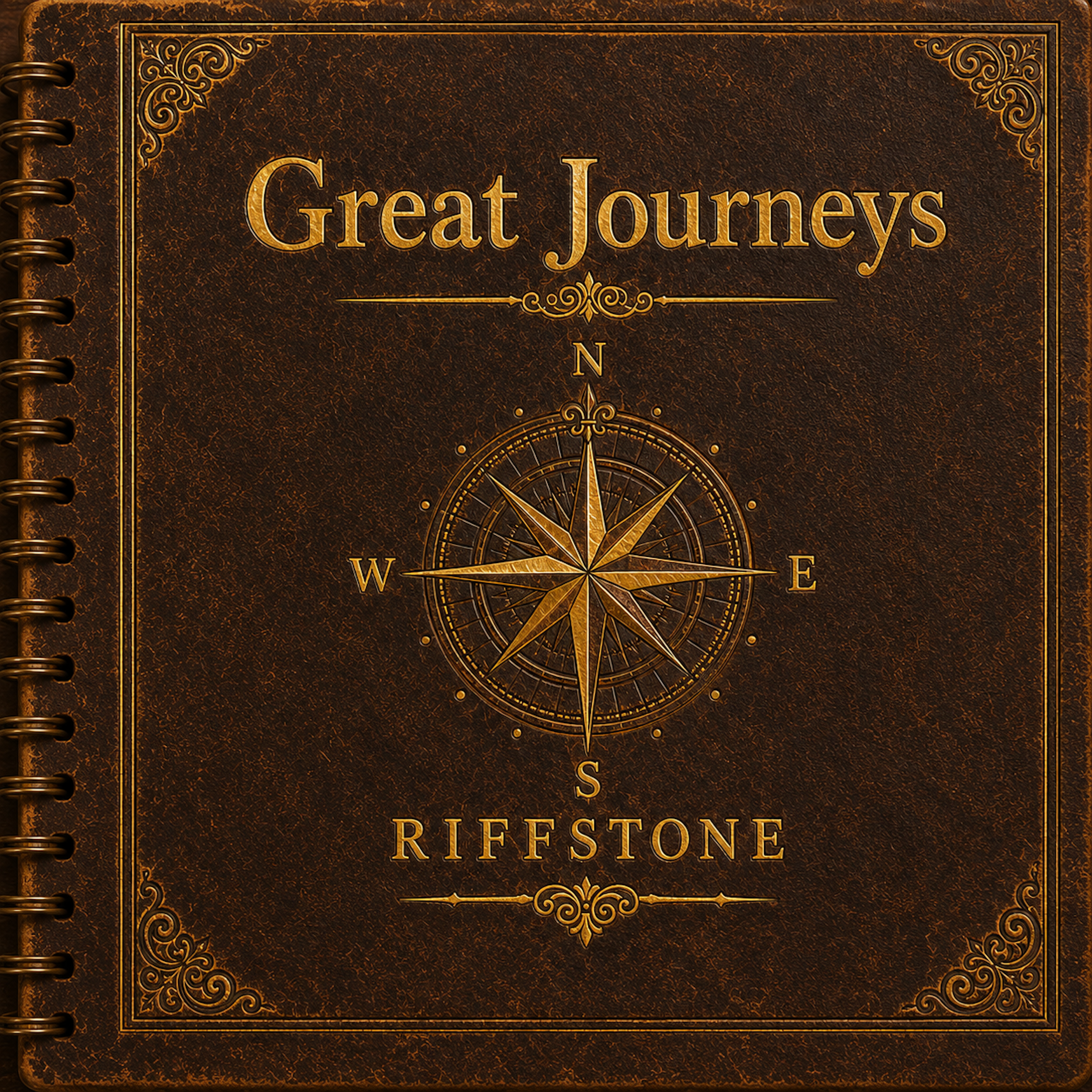
Riffstone, the symphonic progressive rock collaboration between Dave Allen and Colin Powell are incredibly prolific. Their fourth opus in two years, Great Journeys, is available for you to purchase at https://riffstone.bandcamp.com/album/great-journeys and I think it may well be their best, a gorgeous set of songs which imagine our musicians as intrepid explorers travelling the globe, in the grand tradition of those famous Victorian gentlemen.
Nine new pieces of music to find out about, so let’s get to it.
We kick off with The Orient Express, which requires no introduction to readers, and I must say that having regained my confidence in travelling, this is something I would love to take an extended trip on. Paris, Vienna, Constantinople, “from the heart of Europe’s breath to the edge of the East”. Right from the opening sounds of the station, the engine chooing, and moving off on its journey, we are transported to this world. This is, incidentally, one of four tracks here written and performed by Colin, whose voice is instantly recognisable, and we have a mellotron-soaked light symphonic delight, the guitar brightly calling out the landmarks alongside the voice, and I do believe I hear a mandolin singing to me as well. A lovely start to proceedings.
The Silk Road was a network of trade routes connecting Asia and Europe, and older than you might think – they were certainly very well established by the Carthaginian Wars in the second century BC. We are reintroduced to Dave on this, a track beginning with traditional middle eastern sounds, but, by gum, the bass guitar on this as it moves along has the hallmarks of a mighty Squire Rickenbacker riff and some very good heavy electric guitar work. Riffstone at their best and embedded at the foot of this review.
Himalayas is an instrumental, synths at the forefront of proceedings, but also featuring some heavy guitar work alongside urgent percussion detailing the arduous nature of the climb, but, ultimately, the synths bathing in the beauty of the scenery win the day on this.
Camino de Santiago is The Way of St. James in English, a network of pilgrimage routes, which I did enjoy watching not that long ago in one of the more intelligent “celebrity” shows. Not difficult, I know. The guitar solo which introduces this piece is, appropriately, heavenly, no small measure of emotion poured into each note, and this opening passage is worth the entrance price alone. Following this, we settle into a lovely pastoral symphonic rock piece of music, descriptive in the lyrics, the music warm, an intelligent commentary on a journey which continues to attract the faithful in large numbers to this day, with the choral passages nicely spiritual leading to the church organ in duet with the returning majestic guitar solo. Definitely one for fans of classic Genesis and pastoral Big Big Train.
South Pole, where the chasing of glory led (in my controversial opinion) to pointless deaths of extremely brave men. Yes, it was where the brave hearts go, as Colin puts it in the second of his tracks, but what a price to pay. This is the first epic-length track of the album, coming in at just short of thirteen minutes, and I was struck from first listen at the ability to create a stark musical landscape to match the title of this track, raw and lonely guitar notes, ghostly keyboards, a bass riff wondering in the frozen wasteland, solitary piano notes, every breath a battle with the air I breathe. Superb, and embedded at the foot for you to enjoy.
The Voyage of the Beagle, of course, retraces the sea steps of a certain Darwin, and I think it is easy to forget just how revolutionary his opinions and publications were for the society which read them. It had not been that long before that such “heresies” would have resulted in a trip to the stake and a somewhat fiery end on this world.
Mariana refers to the deepest oceanic trench on the planet, located in the Western Pacific, where sunlight fades to cobalt blue, a place so inhospitable, it can barely be imagined. There is some superb acoustic guitar work on this track, with the piano acting as the musical guide to the words describing the journey to the icy depths.
Red Horizon is the penultimate track, with this and the final offering the other Colin Powell performances. This one takes us to the future with Mars exploration, a timely track, in fact, in the world of symphonic prog with The Caped Crusader himself revisiting his Mars travels shortly. This is the second, and longest, epic on the album. The start is pastorally dramatic as the engines are fired. I think the track may reference a Victorian novel about the red planet, A Plunge into Space, by Robert Cromie, where the intrepid explorers find a utopia, a place so perfect, it is, in fact, rather dull. There is more mellotron proggy goodness to soak up in this track, setting the scene for the interplanetary journey perfectly, and the guitar is handsome, with Powell’s bass, as ever, providing a solid foundation. “Pleasant” can be a damning word, but in the context of this song, it is anything but. It is simply a rewarding way to spend your time.
We close with The Maps are Fading to White, the explorers finally going home, but not, I note, humanity, because we still have the great unknown in space to conquer. Those heroes of yesteryear will, I know, be matched by those to come. It is the shortest piece on the album, and acts nicely as a conclusion, reflecting on all we have seen. There is more lovely piano work on this, a distinctive feature of the album as a whole, and once again, Powell uses the mellotron to wonderful impact alongside some gentle orchestration.
Superb, and very highly recommended.