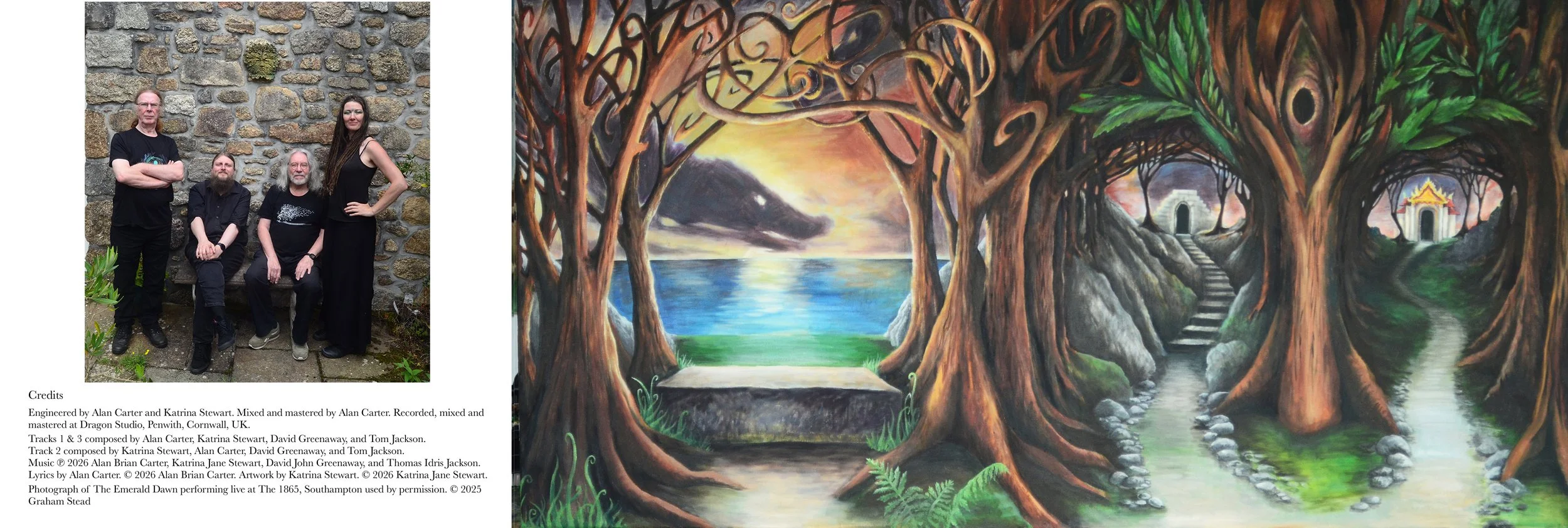
In the twelve years since releasing debut album, Searching for the Lost Key, West Country proggers, The Emerald Dawn, have established themselves as a premier league player in the prog world, their brand of unashamed prog rock going down a treat with critics and public alike.
Last year, the ambitious The Land, The Sea, The Air (Volume One) was released, and you can read my review of it by clicking on the button below.
28th July sees the release of volume two, and you can pre-order both the CD and digital release by popping down to https://theemeralddawn.bandcamp.com/album/pre-order-of-the-land-the-sea-the-air-volume-ii It is highly recommended that you do so.
As I complete my review of this album, the UK is struggling somewhat under the weight of record temperatures for June. There is now little doubt that the change in planetary climate discussed by this fine band is accepted in mainstream academic circles. The political and cultural arguments, however, carry on unabashed.
This album contains a mere three tracks over 45 minutes of music, so instantly you know that two extended epics and a “short” piece at a mere nine minutes are going to tickle the fancy of those who adore the longer form of music. Indeed, opener, Song of the Rainforest, split into four movements, namely Balance, Incursions, Loss, and Regret, is another contender in what is turning out to be a hotly contested Lazland “Topographic Ocean” Award for 2026, this, of course, a tribute to the doyen of the uber-epic by Yes.
It is a track of feeling, of placing the listener in its environment, so we get the sounds of life, accompanied by such a gorgeous organ, with Greenaway producing a soul-infused bassline. Jackson is such a good drummer and percussionist, and I always delight in hearing an Ally Carter guitar solo – the stall is set out from the very beginning, taking its time, allowing you to immerse yourself in a world desperately under threat, but still containing so much majesty and beauty – and this is where the finest symphonic bands have always excelled – you are transported to that world, you feel it, you touch it, the synths creating a soundscape which rises above the tallest of rainforest leaves, but captured within it, an emerging sense of threat, Ally’s sax putting the emphasis on this perfectly, dark, but still rich, conveying the approaching menace of overdevelopment perfectly, four musicians producing a wholesome set, undoubtedly grown from an impromptu jam in somebody’s living room. Darker still is Loss, a heavy air hanging over us, the synths swirling in anger at habitat loss, the rhythm section pulsing its heavy heart. Tree is a very talented flautist, and her plaintive solo here is deeply moving, the remainder of the band allowing this the space to breath. Regret has a Carter guitar solo - moving, conveying the sadness all reasonable people feel when witnessing devastation on such an epic scale, and I would here make a reasonable point that this atrocity should unite all of us, climate change accepters and cynics.
Altogether, this Song of the Rainforest lives long in the memory. It is a startlingly good piece of music, as note perfect a suite of progressive rock as you will listen to in 2026.

How do you follow that? There is an inherent danger on opening with such an epic, sweeping, piece that the remainder gets somewhat lost in the shade, and it is to the band’s credit this does not happen.
Rivers of Tears is another 15-minute slab of music, but there is a change of taste with Tree’s opening piano solo, which would grace any concert hall on this planet of ours, and the resultant duet with Ally is moving, the bassline singing mournfully beneath it, Jackson bringing precisely the right level of intensity required, some quite complex musical patterns developing here. When we get to hear Tree’s voice, some four minutes into this piece, it is lonely, full of regret, her brogue perfect for the piece, Ally then taking the lead with his sax, with the quartet producing another nice passage with jazzy improvisation at the core, this leading into another of those guitar, synth, rhythm passages they do so well, each having a level, but as a whole, very much brought together as one. Through the rivers flow the lifeblood of the land, and we pollute them at our peril, and this exhortation precedes a fascinating burst of psych rock, reminiscent of classic days of yore, the poison injected into the veins wrought large with a mighty dose of dystopia, the drums crashing through the speakers at the death. Superb.
We close with Paradise, Tree’s voice against some eastern mystical notes, taking on such a deep hue, mournful of the fact we are losing paradise, the guitar solo crying out. This is an appropriate close to a set of albums addressing mankind’s imbecility as regards how we treat our home, and, as such, cannot be described as anything other than deeply intense and sober, some of the synth blasts coming out at the top fit to make one weep.
This is a fine album, and a perfect accompaniment to Volume One. Taken together, they represent a musical triumph, and important additions to the debate about how we could, and, indeed, must change how we consider economic wellbeing. Hint. It ain’t merely GDP.