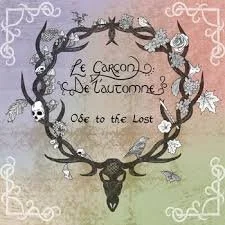
A couple of years ago, I reviewed an EP, Prelude to Farewell from Le Garçon de l’Automne (The Autumn Boy), the pagan folk project of Quentin Maltrud. You can see the review by clicking on the button below.
Come 2026, and we are treated to a new album, Ode to the Lost, which he describes as the second part of the Diptych of Grief. You can find this work on Bandcamp at https://legarcondelautomne.bandcamp.com/album/ode-to-the-lost-2
I referred to the music’s ability to bring joy, a reminder of simpler times, filling one with life, this becoming increasingly important in this frenetic and seemingly constantly troubled modern world.
We have songs about L’Ankou (the official video for this is embedded below), the servant of death in Breton mythology (Ancow in Cornish, and yr Angau here in Wales); the Sirventes ('service song') which was Old Occitan lyric poetry practiced by the troubadours; Baba Yaga, a forest-dwelling witch in Slavic folklore; Ars Moriendi, which was a popular literary genre in the renaissance period for people seeking a peaceful death; Koppije, medieval chanting; Le Chant du Cygne, or The Song of the Swan – all told with a joyous swagger and dripping in the traditions of our forefathers, reconnecting us with their lives, beliefs, and nature.
There is a nice hue to the vocals from the off in Blue Souls, those spiritually aware individuals, male and female acting in harmony, and the underlying percussion familiar from the last EP striking a note of complexity, guitars, hurdy gurdy, a raw feeling, the closing passage deliciously ethereal with the female voicing dancing around a naked fire.
I struggle to think of a more adept player of hurdy gurdy than Maltrud. The darker themes (L’Ankou, for example, is about finality) are not doom-laden, they are respectful of both tradition and humanity. The mixing & mastering by Mathis Delepierre brings us a modern vibe, not easy with this type of music. There is a spartan feel to Et Gris (And Gray), with haunting penny whistle, guitar and voice adding multi-layered textures to a deep French traditional feel. In contrast, the Old Occitan poetry is a joyful noise, an ancient disco beat beneath the words and prominent instruments.
When the Wind is Alone is a pretty love ballad, yearning to hear her voice across the seven seas, quite gorgeous as it moves to its denouement, the voice and single notes on the piano in the ether.
She is the Sea is not far short of an epic-length track, so plenty to get our teeth into, the deep recorder against the acoustic guitar at the start evocative, before the pitch and tempo rise with the introduction of percussion and the whistle picks this up before we get a halt to proceedings at the four-minute mark, a pause, and then pipes introducing the voice, softly spoken, an expression of Celtic culture, before a segment of music which is achingly lovely, using perhaps a baroque guitar with the waves in the background, soothing, yearning, and a true highlight of 2026.
Baba Yaga is, I believe, full of mischief, the witch tempting us with her words and music into her forest lair. Emma’s Waltz is fun, a hurdy gurdy solo delight to start plus a gypsy acoustic guitar solo, and you picture Emma and her beau dancing a whirl to the joyful noise.
Ars Moriendi is, as would be expected, a more laid-back affair, but it is not mournful by any stretch of the imagination; indeed, the pace of it quickens to provide a repose for the soul in anticipation of the final journey, the spoken words a balm, the choral voices soothing.
Koppije almost serves as an interlude – chanting, and fascinating in its way.
The swan is a majestic creature (it is still illegal to kill a swan in the UK for food without the express permission of the monarch), and Le Chant du Cygne portrays this perfectly. Listening to the recorder and strings, underpinned by a low hum, put in my mind’s eye a procession of the creatures, the lead bird proclaiming its strength and leadership in no uncertain terms as the tempo rises, before the rest bow down in submission, the strings quietly demonstrating the supplicants.
We have another official video for Above the Lake, embedded below for you. I particularly like the touch of him righting the beetle upended by his march through the woods, a respect for life. This is a clever musician, and it is the second example here on the album of the use of the jaw harp keeping a steady beat, the violin playing minstrel flying over the lake for a powerful duet. Following this, appropriately, we have Rising, the A Capella providing the backdrop to this fascinating musician and wordsmith’s personal journey. The music then brings all the themes of this impressive album together in such a joyful noise, at times soaring, at times merely voice, guitar notes, and drum quietly expressing thanks for the awakening of soul.
Le Garçon de l’Automne has again provided us with a wonderful album, deeply rooted in our shared traditions, exceptionally performed, and I have no hesitation in recommending it to you.