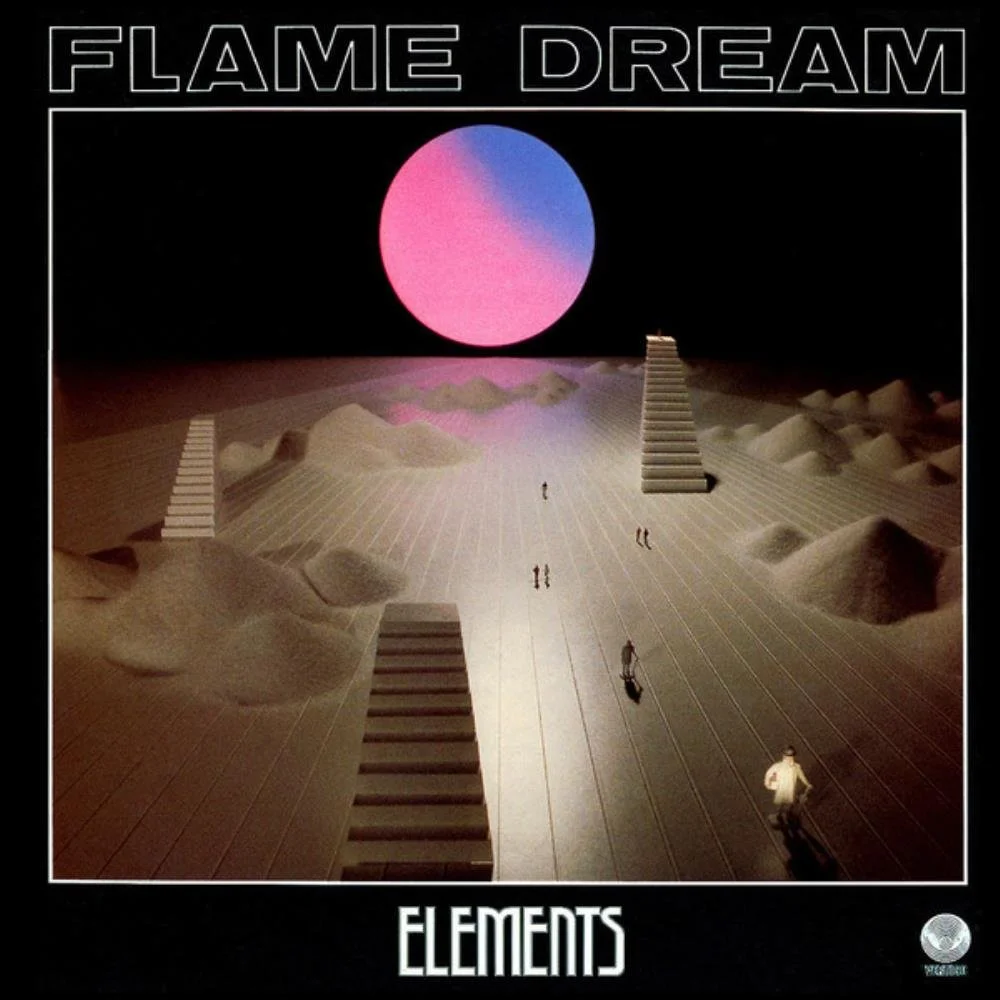
Flame Dream, the band founded in Switzerland in 1977, and recently reformed following disbandment nigh on forty years ago now, continue a series of reissues of their past catalogue with a lush CD-digipack of Elements, recorded in 1979, and released at the start of 1980.
You can see my review of the first reissue and the subsequent album of new material by clicking on the button below
The lineup again here is Pit Furrer on drums & percussion; Urs Hochuli on bass & voice; Roland Ruckstuhl on piano, organ, and keys; and Peter Wolf voice, flute, oboe, sax, and percussion.
Doubtless, the band demonstrated no little ambition in terms of progginess by having three epic-length tracks on an album of only five pieces. It is available at https://flamedreammusic.com/
Let’s discuss it.
We start with Sun Fire, somewhat limply only just creeping in to the epic category at two seconds over the threshold. We start with the crackling fire, some effects, and general chaotic improvisation, the noises then coalescing into a symphonic jazz session, Ruckstuhl creating a warm overview above the effects, the drums crashing out the undertone, and it is when the oboe of Wolf enters that I ceased other thoughts, and began to appreciate a warmth emanating from the speakers. The flute adds to this, and lovers of classic prog rock, ignoring the punk haters, can sit back, relax, and allow the track to wash over them. The vocals and entire scenario are warm and soothing. Lyrically, the song references Prometheus, the titan who took fire from Zeus, and gave it to us mere mortals, and, for his troubles, was banished to eternal torment, and the synths absolutely provide us with the drama inherent in the story, the sax then leading the charge to a delicate close. Ultimately, humans are the sun, the fire. Dramatic and satisfying. A video is embedded below for you to enjoy.
Sea Monsters is the longest track here, just shy of 13:40. Creatures of the sea have, of course, been the stuff of legend over millennia, the battle between man and the elements at the core of the stories, and ultimately, we always lose against the might of nature. As we start, the sea washes against the shore, a grand piano giving a sense of the drama to follow, although there is a playful sense to it, and, indeed, the voice, and band give rise to a classic symphonic shanty, the whole sense of it strongly influenced by early Genesis, with a twist of manic VDGG and residual Lindisfarne. Hochuli provides us with a thundering bassline throughout, and those who love a pastoral flute in their prog will find passages to delight here. In parts, this track is also extremely catchy, reflecting the care and love which went into producing it. A blend of classic prog rock elements (pun quite deliberate) which pleases the listening palette. As the band play between themselves, the result brings a huge smile to my face.
Earth Song has many words in a far shorter song, a sort of lawyerly argument between mortal and superior forms, with the only reference I can think of in progressive rock history to the Heritors, those learned chaps of privilege in Scottish parishes in the days when the inhabitant of The Manse was all powerful. Lots of synth and sax pushing & pulling, both providing for such a rich sound, beneath which the bass pounds a solitary theme. Playful stuff.
A Poem of Dancing is the final epic, again more than thirteen minutes of music, lyrically bringing together all the classic elements of our ancestors, as opposed to the chemical tables which bored us silly in our latter-day education. The oboe singing as we start provides for the promise of a classical symphonic delight, the percussion and light tinkles on the keys, the voice carrying with it a sensitive narration. As we progress, there is the feel of classic seventies TV theme tunes – think the original Mission Impossible, and you are there. There is some wonderful interplay between flute (dancing, twirling) and bass guitar in some extended instrumental passages, with the piano then joining in the fray, the musicians proving beyond any doubt that they have the chops to stand comparison with the most beloved of that era. The drama, especially with the organ rising, is classic prog as we move to the close, a sax and synth seeing us out. It never loses its focus, and that was not, and still isn’t, an easy thing to pull off.
There is a short track, Savate? Nose! to finish off, a light VDGG-esque improv.
For those of you who enjoy grandiose and ambitious symphonic progressive rock, this album is for you. You might not remember them, but they are curating their work with love and pride and deserve your attention. Definitely recommended for lovers of those halcyon days of symphonic progressive rock.