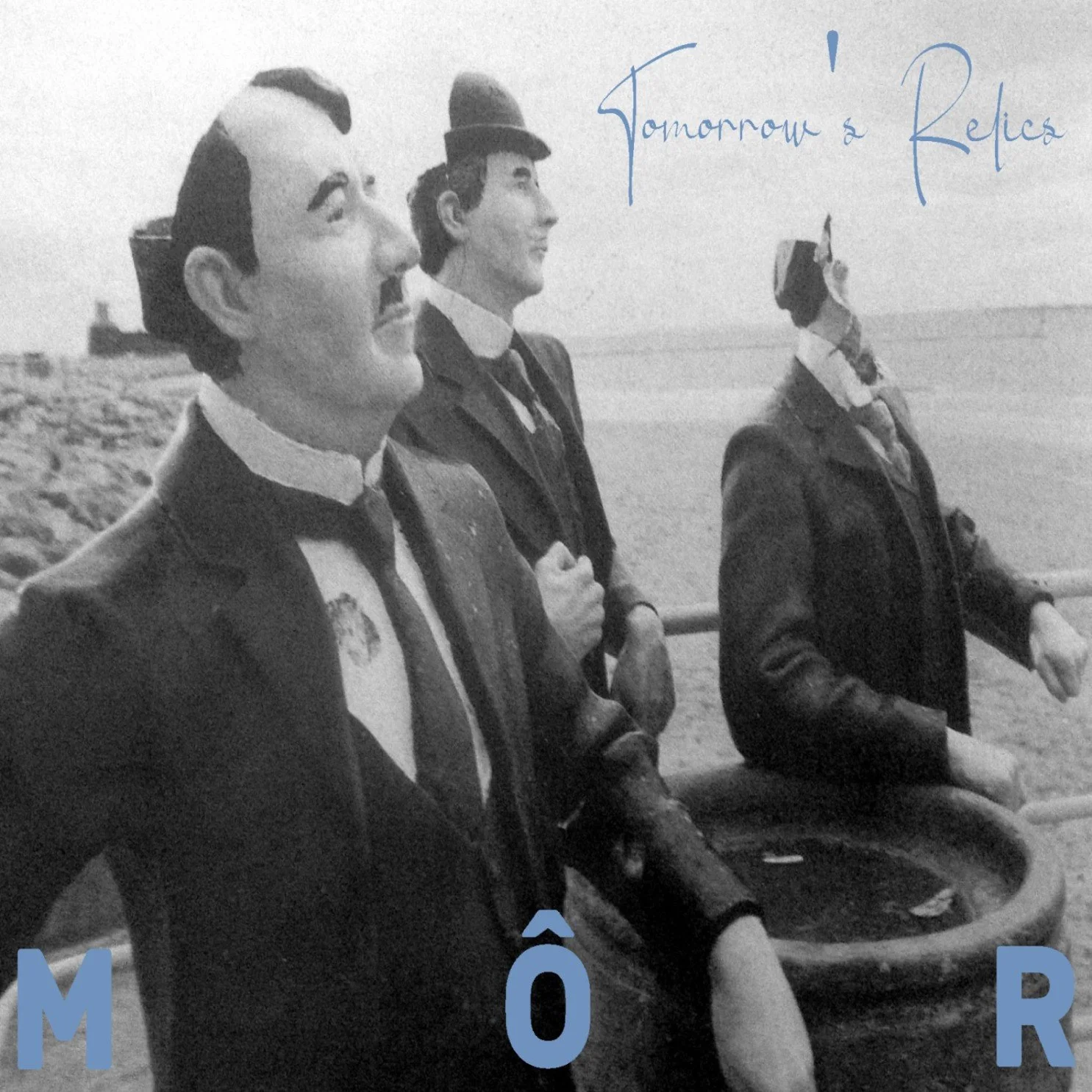
Môr, the multinational project featuring Ramlee Oak (vocals, drums, bass, keys), Peter Rand (keys, guitars), and Chris Matthews (guitars), now joined by Alex Fadista (guitars), release their sophomore album, Tomorrow’s Relics, available to be heard and purchased at https://mor2.bandcamp.com/album/tomorrows-relics For those of you who like physical copy, there is a link on the page to where these can be obtained.
This collective, rightly, have been garnering much attention and praise in the progressive community, and they do not disappoint here with seven pieces of music.
There was an album teaser released, and I have embedded that below for you. The notes that accompany this by Oak provide an explanation of the concept of the album, thus:
“We occupy both space and time and, assuming the physical cosmos is infinite, perhaps time is as well; it never started and it will never end.
According to ancient Hindu belief, time is both eternal and cyclical, not linear. The Tibetan Kalachakra (wheel of time) represents, among other things, this cycle that plays out on a time scale that dwarfs any practical relationship with an average human life.
The rise and fall of human civilisations, indeed, the entirety of human history, is but a single grain of sand on the Kalachakra. As if that were not confronting enough, we're beginning to realise that we have a very incomplete picture of our ancient past.
It was only 30 years ago that excavations started at Göbekli Tepe in Türkiye, revealing a vast site of previously unknown monolithic architecture - erected, and then deliberately buried, more than 11,000 years ago.
Our relationship with time is both tenuous and transient.”
Ambitious, and, of course, absolutely bang on the money in its observation of our understanding of history, which has always been written by the winners, the losers either buried, or slandered with a false narrative which lingers perpetually.
We start with Timeslip, the Wheel of Time spinning on relentlessly, the seasons repeated, moving up the slopes of the five-peaked Mount Meru, the centre of consciousness, physical and spiritual. The song is bright, some interesting effects on the keys with Rand as it develops taking an ethereal lead, with a rhythm section pushing matters along nicely, the bass melody especially crisp. Ramlee Oak is a descriptive vocalist, and as we progress, you hear in full flow the sound of guitarists in peak condition, some lovely bursts coming out. A strong start to proceedings.
It is followed by The Nine, a fascinating lyrical journey recounting the Titan, Mnemosyne, who bore nine Muses by Zeus, with each of them given space here. There is a lovely sense of the pastoral from the off, a beautiful bass melody again, the guitars adding a sense of layered mystery with some fine riffs encountered as well. It is classic progressive rock music in that there is a lot going on in this track. Heavy bursts, folk rock, jazz fusion strong in the foundation of bass and drums, layered synths, thoughtful ghostly guitar solos, the rising tone and emotion at the close a delight. It is embedded below.
Thirty-Six Barrels is a wonderful tale of the plot to blow up Parliament and King James I of England (VI of Scotland), and wonders whether Fawkes was a hero, or, as he is portrayed now, certainly by being burnt at the stake each year, a villain. If he were here to tell the tale now, what would he say? The synths and drum roll presage a tale of drama, the conspirators meeting, the guitars telling of their plot. To the already impressive roster of fine modern folk-rock can this track be added, the soaring church organ a delight, all of it very catchy, the pipes hailing the King and survival at the close.
I can relate to Quiet Time, certainly in the manner of one growing older, scorning the youth of today, crying just how much things were done better back in the day (in my day!), and, certainly in my case, absolutely no flair for brevity whatsoever! No matter how much you tell yourself off for slipping into this mode and way of relating to the world, knowing it is wrong, well, sometimes one just can’t help it. I just love the guitars at the start, a touch of Americana in there, heightened by the harmonies, the gorgeous guitar solo midway which is overlaid by some sensuous keys, the rhythmic chants and thuds which close. I really like this track, and it is embedded below for you.
The title track follows, referencing The Göbekli Tepe Pillar 43, with its vulture, scorpion, and ball, hidden meanings lost in the mist of time and argued about by historians, philosophers, mystics & etc. In the meantime, we continue our journey, inventing ever more wonderful things, but in a world of disunity, no clear purpose, the lyrics hoping for the day in the future when the ships will arrive, and set us back on a clear path to wisdom. The electric piano and the woodwind create such an atmosphere on this, reflective, before the band rock out after the close of the opening verse, an expansive noise which is as surprising as it is strong. Sven-Martin Keil provides some lovely saxophone on this, the track veering between quiet contemplation and anger at the loss of yesterday’s wonders and our present state. Some of the guitar notes are deeply moving as the backdrop to voice and sax. Very impressive.
Risk Averse rightly bemoans our tendency to stick with what we know, including some of the awful vagabonds who rule over us, and provides Prometheus as an example of daring, banished by Zeus for giving fire to humans, who he had originally created from clay. There is an interesting groove to this as we start, entrancing, the first guitar solo adding a nice complex fusion vibe, but this is interspersed with a nod to Beach Boys halcyon days, but I also hear some references to 90’s pop stars, Thompson Twins (that is not as bad as you might think), the main guitar riff pure classic rock, ancient talking drum beats against the strumming guitars, so quite an eclectic wee mix in here, perhaps a musical expression of taking chances? I like that, and it.
We close with Ravenstongue, anticipating the glorious day when we cut the tongues of the raven overlords and are saved by the silence. Imagine that with Trumpalot, Starmer, the lot of them – beatific nothingness spouting from their mouths. We have a video for this which is embedded below for you. The drum riff as we kick off reminds one of Fleetwood in his pomp, the bassline a fine groove against it, a great guitar solo, a pretty synth which never seeks to dominate, instead allowing the message to be heard, the march to freedom ultimately joyful and filled with a symphonic rock joy.
When I recently co-presented a special folk rock show with Thomas Szirmay (The Prog Rogue), which you can listen to at https://progzilla.com/lazland-on-progzilla-radio-episode-69-prog-folk-special I had a message from a friend bemoaning the fact that Môr and this album were not featured. I agree with those sentiments, but these things are planned some way ahead, and the album arrived with me too late for that, but it will most certainly appear on a future show such as this, because Tomorrow’s Relics is one of those albums which intelligent music fans should be proud of owning. A concept which provides huge space for individual interpretation and thoughts, well recorded, extremely well played, and with a variety of musical themes on a large canvas.
Very highly recommended.