
Lazland
Hi John, and thanks very much for giving us your time.
John Mitchell
Thank you very much for having me.
Lazland
We’re going to be talking all things Lonely Robot. The new album is the sixth in the series. My understanding is that it is designed to bring a closure to the saga, bringing it full circle, as it were.
It's the end of a decade of inspirational creativity as a solo artist on your part, so before we go into discussing this in any great detail, what are your feelings about it all coming to an end?
John Mitchell
I feel in some ways…. I wouldn't say conflicted, but of course that's just the sense of nostalgia that we all have about things that have gone on for some period of time in our lives.
Certainly, I feel that it's been the most productive decade of my life.
I don't really have any regrets about it. I think, you know, if it hadn't come to pass, there might well have been never another opportunity. I spent so much of my life being in bands and operating within a sort of cyclical movement within the framework of other bands that, really, I would have happily continued doing that.
I think if you are ostensibly a guy who, or a human, that operates within the construct of a band and realises that you're the person doing the heavy lifting, writing all the songs, writing all the lyrics, carrying the creative side of it. I guess I found it difficult.
Bands are very difficult things to operate within. The best band that you'll ever be in is normally probably the first one that you join, when you're all like-minded and have a similar aspiration.
As you get older, that changes, and I do think that some people become quite megalomaniacal, and Machiavellian in their pursuit of power within the band structure. I kind of found that, you know.
The only bands that really have served us well over the years from an early age that are still around today are the ones that split everything equally. And I don't think I've ever been in a band where that has been the case.
Certainly, it didn't feel like there was an equality at the time, you know. So, I think Lonely Robot as a venture was certainly very important to me to address that balance.
Lazland
What you've just said puts me in mind of Nick Mason's comments about Genesis, you know, he was talking about all the shenanigans going on in The Floyd, and he said, I really rather wish we could have split up like Genesis, that's the way to do it. I don't think many do, do they?
John Mitchell
Oh, I think that rather exemplifies my fact, as he's talking about his own experience In that band and obviously it's not for me to comment on the internal machinations of Pink Floyd, but certainly the version of Pink Floyd that I favour and the one that I enjoy is the one with Roger Waters. You know, some people prefer the sort of hippie version of Pink Floyd.
I like the slightly angry version of Pink Floyd that gave us The Wall and The Final Cut. And without Roger Waters, there wouldn't be those two albums, without a lot of infighting.
I listened, weirdly, last night, to The Pros and Cons of Hitchhiking, and I think that was probably a step too far. It sounded like a like a teeny new version of what he was doing in Pink Floyd. And maybe I'm going to get hung out to dry for saying that, but nonetheless, it's what I believe.
Lazland
I really like it. It was rejected by Dave Gilmour, I believe, in favour of The Wall. That's my understanding.
So, 11 years ago you started off with Please Come Home.
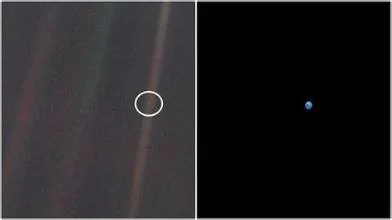
The first trilogy, our eponymous hero, looking out as it were. First off, I gather that the inspiration behind the project in the first instance, was that rather famous and lovely request from Carl Sagan to turn the camera around to have a look at Earth as a pin prick in the distance?
John Mitchell
Yeah, it's always fascinated me.
I think if you're going to make rock music or prog music… the trouble with music is it is regarded at large as disposable light entertainment, and I don't mind that. There was a time, actually, I didn't really care about that. I think Alan Rickman said it best when he said that what we do, and he wasn't talking about music, he was talking about theatre, the arts as a whole, he said that what we do is, by and large a means of bringing light into the world of those that do something important.
And nothing more than that. So be it Kylie Minogue, be it Lonely Robot.
Obviously, my music is not aimed at everybody. And Kylie's music isn't aimed at everybody, although I do like Kylie Minogue. So, there we go. I would suggest that when I started out on this journey making this music, yes, I mean, it might seem pretentious, but I always think about the expression of art as it were. And what are you trying to say? The things that have resounded with me not just in music, but in the field of… I mean, I did an art scholarship at school, and so the paintings, the pictures, the music… it's always been the bigger things.
There's a painting called The Fighting Tameraire, a very famous painting by Turner, which represents the end of the Sail Age and the coming of the Steam Age, which represents a ship dragged towards the docks in the East End of London. And it's always been a very provocative image, and I've always sort of thought that's the thing that kind of made me think more than anything else.
There's a picture by Hogarth which is a painting of a lot of people on the Titanic, the other side of the coin, as it were, and that's always interested me. And so, with music I always wanted to write music about things that people don't necessarily always think about, and Carl Sagan.
turning the camera around on Voyager 2 was a seminal moment for me as a kid. It really made me think about it.
Lazland
Yes, it did rather put us, in the context of infinity.
John Mitchell
It does.
Lazland
I adored the film version of his novel, Contact. Jodie Foster was in it in, made in ‘97.
Very, very intelligent. Is anything that you've done been inspired by that, or other Sagan work?
John Mitchell
Everything. That film, the fact that you should mention that film, everything, everything in my life has been inspired by that.
Without any shadow of a doubt, my favourite film ever.
You could argue now with the benefit of hindsight they wanted a bit of eye candy, and McConaughey was the guy at the time to play the role of Pastor Josh, and it's a little bit clumsy in its casting, I suppose. But the mission statement from that film has inspired me endlessly. It really is, without any shadow of a doubt, the most underrated… The amount of money that was chucked in it, Robert Zemeckis film, it was just an incredible film.
The moment when we see Jodie on the beach, as it were, revisiting her dad.
I know that that's always stayed with me because, of course, what you're trying to do is explain to people through the medium of appropriation, you know, trying to explain that this is how best to talk to people. This is how best to communicate the message we're trying to give through the meaning of something that you're aware of already is a really kind message, but it gets lost on some people. Why is she talking to her dad on the beach? Well, that's not really the point, is it?
Lazland
No, I don't think that it is.
John Mitchell
When I found out my dad had died, you find a gentle way of explaining. You don't bombard people.
With Contact, the James Wood character is perennially the guy questioning the role of aliens, and whether they're megalomaniacal, and whether they're malignant.
Whereas the message that he's the powers that be. He's in the sort of position of defence, the governmental position, and on the other side of it, which is what the film is trying to tell us, is that were we to meet somebody from another galaxy, would it necessarily end in World War III?
Which at the time, when you think about all the science fiction films up until including that point, was always the narrative, the message, was War of the Worlds, the Martian invasion.
All these things are attacking. Well, why would they? Why would you go to the trouble of invading an alien? Well, not invading, but making contact with an alien world. And of course, James Wood's characters say, why would they always be of a docile position?
Well, why not? Why would that not be the case? Why do we assume as an aggressive nation that the people that make contact with us are the aggressors? And of course, that is the message of the film.
Lazland
I couldn't agree with you more. I absolutely love it.
One of the tracks I'm going to be playing on the radio show at this stage in the interview, or maybe after this particular passage, is Airlock, which is, of course, the introduction we had to the whole saga. Now, there's some powerful stuff on that first LP, and I've enjoyed revisiting all five of them these last couple of weeks.
At the end of the first one, there's the baby crying at the end, so that's the second sci-fi reference I wanted to ask you about, because you're absolutely right in what you're saying about contact, so the difference between the military, political mindset, and those of us that like to aspire to nobler things.
The higher intelligence, for want of a better phrase, of a race that is capable of reaching out to us like that, just saying, right, well, thanks very much indeed, you're not quite ready yet, we'll come back in a couple of thousand years, and hopefully you will be, or we'll keep an eye on you. And that was, to me, a similar sort of message with 2001 A Space Odyssey, the original short story, and Kubrick and Clarke on the film.
And the baby crying at the end of the album reminded me of that. Is that a fair comment?
John Mitchell
Entirely intentional, absolutely entirely intentional.
That sound design was actually very kindly put upon me by Jem Godfrey, when I said to him, I said, okay, so this is the opening of the album, and I want it to be a bit confusing.
So, what you don't hear is, well, my favourite creature on the planet, the cat.
Cats as a species are mimics, right? They are far evolved from any other creature, far more advanced than we give them credit for. They go back so far in our world.
I always think that cats, the way they behave is so strange to me. I find it bizarre. You know, they do things that, daily, I go… I look at my cat and I go, what are you doing? What are you doing?
And the way they communicate with us is so odd, but so probably not odd if we knew what they were saying. And cats are always saying something to us. And then that sounds really hokey, but dogs, you know, they jump up, and we pat them, and they're happy. Your cats aren't that simplistic. They've got something going on that I still can't put my finger on.
In that song, I really wanted it to be the voice of a cat turning into a baby. "Air Lock", it actually starts live. That noise right at the end of it is a cat transmogrifying into a baby. And I just thought, well, that's going to confuse a few people, because it confuses me, because that's what cats do. When they make that noise at you.
It's not them going, I'm a cat, I want food. It's them going, I know what a baby sounds like, I'm going to make a baby noise, and then we're going to go… that will in turn make you give me food. That's what they do.
Now, if you can find me another creature on the planet that is as good at impersonating other things to get the warranted result from them. When they hiss, they're impersonating their mortal or feared enemy. They're making the noise of snakes.
When they meow, they're impersonating human babies, they have got a thick, way, way, way, way darker entrenchment into our psyche, going back thousands and thousands and thousands and thousands of years, way back to the Egyptians.
They have got something going on that, you know, and I certainly don't, and I've got the world's most bonkers cat, and to this day, I'm confused by it. So, that's where that noise comes from at the end
If you listen to it closely, that's a cat turning into a baby.
Lazland
Well, okay. That's absolutely fascinating.
So, this is probably going to sound like a strange question, I don't know, but Lonely Robot as the protagonist.
Are we talking about a machine or a human or a juxtaposition of the two?
And the reason why I ask that are those lovely words at the end of the LP, which is reproduced at the end of the first trilogy.
“Please come home, Lonely Robot
Your heart is beautiful
Programmed to receive
We miss you now, Lonely Robot, ever so beautiful”.
Gorgeous, and that prompted this question.
John Mitchell
I think what I didn't know I was doing when I started this thing, because it wasn't really made clear to me what I should be doing.
I was given a blank canvas. I remember that I had a meeting with Thomas Farber at Inside Out (EDITOR’S NOTE: the original record label for Lonely Robot) and he said do you want to do another keynote record? And I thought about it and I thought, well, the thing about being in bands is I do love being in bands from a certain perspective. I love the camaraderie of being in a band. I enjoyed a lot of that, but then, of course, the trouble is that you also have to contend with people's personalities.
That's not to say I didn't get on with everybody in It Bites. I did get on with them very well. But you know, at some point you're going to have a conflict of interest about one thing or another.
So, I knew from the outset that doing Lonely Robot, it was going to be me on my own. What was I really going to say? And a lot of the things that I'd written with It Bites were going to be very personal things.
But what I realised quite early on was I was given a very definitive framework to work in. Thomas Farber said to me, it would be better if we were to present this as a band because bands sell more units or records than solo artists. I had a bit of a (it was in a sushi restaurant in London) and I had a bit of a to and fro with him going, well, that's not true, is it? Let's be honest! What about Phil Collins? What about Peter Gabriel?
And he probably won't thank me for saying this, I said to him, can you give me an example whereby, you know, because I wanted to release music under the title John Mitchell. I said to him, can you give me one example of a band that has sold more units than a solo artist. And you can't say Phil Collins, because historically Phil Collins sold more records than Genesis, as, did Peter Gabriel, compared to his time in Genesis. You know, it's all relative.
And he said to me, yeah, on a slightly lower scale, The Neil Morse Band sells more records than Neil Morse.
Lazland
Fantastic!
John Mitchell
I thought, yeah, I've got nothing. So, I said, okay, well, then we'll call it something else. And I thought we'll call it Lonely Robot. And the reason I called it Lonely Robot was because I heard Sting’s daughter, Eliot Sumner, who released an album called I Blame Coco, which is a really, really, good album of electronica. And one of the songs on that record was called Self Machine, and there was a lyric; “lonely robot in a harbour… lonely robot in a wasteland rusting in a harbour's water”.
And I just thought, wow.
What incredible wordplay. And I thought you know what?
I'm going to have that. I'm going to call it… if I can't call it John Mitchell and steal all those millions of sales, I'm going to call it Lonely Robot.
What I have come to realise, in answer to your question, is over the years of doing this, I have come to realise, from writing in the perspective of the astronaut is a lot of the things that I'm writing about, a lot of the metaphors I'm writing about, about…
The inability to go home.
you know, ultimately, just arrive.
And this might come as the most hokey thing I ever say, but it actually derives from the fact that that's how I feel. As an adopted kid, that's how I feel.
I don't belong anywhere.
When I decided to start doing this, I kind of came to realise I don't fit in anywhere. I don't fit in any social structure.
I don't.
I can feel chameleonic. I can go to any event, and I can sort of get on with anybody for any short period of time, but I don't feel like I genuinely belong.
And sometimes I talk about my family, and even then, I don't feel like I belong, because I know that I was plucked out of obscurity.
So, I think, If I'm being perfectly honest with you, the whole lonely robot thing, he's probably singing from the first person rather than the third person.
Lazland
Well, thank you for sharing that with me. Strangely enough, we at home, we're having similar sorts of conversations ourselves about things that happen to you, things that you see, things that you experience which make us the people that we are. And I think what you've done extraordinarily well is to put that across in the context of your music, you know?
There was a thought I had, again, when listening to these LPs. It was the thought of an eternity just floating in space. Just floating forever, never able to come back. That's all it is forever, and that is probably one of the most frightening thoughts that we can have. It was interesting that came across.
John Mitchell
It is. As social beings, we are bound by social constructs.
And the reason, again, I think I've spoken about this before, a couple of songs I've written in my life have been about Donald Crowhurst, who was the guy that entered the round the world yacht race.
And he never completed it, because he didn't have the skills to compete, he basically, was doomed from the start, the boat wasn't ready, and yet he was bound to complete the mission, but he couldn't complete the mission because he didn't have the skills and the boat was leaking from the moment, he set sail.
He forfeited everything, everything he had.
His story is one of, you know, wrestling with this for nine months at sea, pretending that he was part of a yacht race that he wasn't really part of, skulking around Argentina, hiding away, within sight of the coast, waiting for everybody else in the race to come round and then tucking in behind them, pretending that he was part of it so that he might keep hold of his home and his dignity.
Now, I've thought about this, and history doesn't remember him well.
And I think it should.
Because ultimately, he threw his lot in with a dream and a belief that you can do this. This is something achievable.
But at the time, it was very much a culture of if we can't complete something, then it's better to save face and pride.
Pride comes before a fall, right? And in his case, the biggest fall, you know. There was no way that he was ever going to complete that race.
But he spent nine months fighting with his own brain, going around the twist, realising he couldn't do it. And for me, that is the greatest metaphor.
You know, there's so much music out there, and if there's one thing I do, writing music, it's I would hope to get across the message that really nothing weighs greater than the value of human life, you know, and that sacrifice in the name of pride was such a colossal waste.
Lazland
We'll go on to you as a musician.
You listen to all these LPs, and the latest is the best example of it, I think. Most people if they are asked, what do you think of John Mitchell? And they'll say, bloody good guitarist.
Not a bad vocalist, either.
And they wouldn't necessarily associate John Mitchell with keyboards, with programming, with virtually everything else apart from the drums. But I think especially on this new LP, that you have become a true multi-instrumentalist, is that the best way to put it? Because the soundscapes on this one are staggering. They really are very, very, very strong.
So, I think that's been a wee bit of a journey for you, hasn't it, over the past 10 years?
John Mitchell
I think what people don't realise, and of course, actually this was an intentional thing, was that since I was knee height of a grasshopper, all I've ever done is music, right? And I learned the piano and I learned the violin.
And I learned the guitar later on, but what people, possibly in the world of progressive rock, don't know, is that I had a parallel career as a music producer from probably the age of 17 or 18 or 19.
And for all that time that I was doing all these little bands and ducking in and out of Arena and John Wetton and all that, at the same time, I was producing quite a large number of popular rock and pop acts.
No one's expected to know. I'm not pretentious enough to suggest anybody would know anything about me, if you were to know anything, I made a very conscious decision at the time that I was doing Lonely Robot, or all these progressive rock bands, I kind of felt that the two worlds didn't really exist together.
Like, I think there was one time when somebody who I was producing figured out that I was also a musician. I was producing Funeral for a Friend.
And Ryan Richards.
This was when Google was in its infancy, I suppose. And he found out that I was in Arena, and he found some footage of me playing guitar online. He was like looking at me on the desk and looking at me going, hang on a minute! What’s going on there?
And it was the only time in all the time that I was producing these bands that anybody ever figured out. And until, of course, very recently, when everybody that I've ever produced started messaging me about two weeks ago, going…
Holy shit, are you in Asia?
And I'm going, yeah, yeah,
“I didn't know you could play guitar”.
I mean, yeah, I can play guitar a bit, you know.
And that's, that's, I just made a point of going, that's over there, that's my production life. That's, Kerrang, that's all this business and that's Radio One and all that. And over here is me with my capes and pullovers.
I didn't think there'd be any cross-pollination of interest, so an answer to your question is, I spent my life producing records. I understand how to produce records. I understand what I can play and how to play it. I can play most… well, not most instruments. I can't play the Brazilian Motor Split, for example, but I can play the instruments required to make the music that I need to make, and I think I can do it very well. I can even play the drums a little bit, but shh, don't tell anyone!
Lazland
Correct me if I'm wrong, there's only the two of you on the new LP, and the drumming of Craig is the one constant alongside you since the first LP, and obviously, you play with him in Frost*.
He's a damn good drummer, isn't he? I mean, he's added a hell of a lot to this project.
John Mitchell
I think more importantly than that, he's one of the funniest people I know.
I think that's more important. Yeah, he is a very fine drummer. At the risk of sounding like Simon Cowell or Mickey Most, I did give him a bit of a break.
I did get him a job with Steven Wilson, and whenever I can, I always try and get him to work with other people. I feel like his agent, but I'm not on commission, so, certainly when he got the job with Wilson, there's a lot of what I would describe as cesspool behaviour on forums, and he really bore the brunt of a lot of hatred from a lot of people going, you know, Marco Minneman! How can we possibly have Craig Blundell?
It was all about what I would describe as folk singer mentality. We don't want change!
I kind of witnessed all that with him, and I went through a lot of it myself when I joined it Bites, and it's like… he's not tall, he's not blonde, and he's certainly not a helicopter. He's not Francis Dunnery. How could he possibly lead us into hope? You know, and then, of course, we did two albums, and a lot of people liked it, and now we get it again with Asia.
I think the thing is, certainly with Craig, I think that he's an incredible musician.
But it just goes to show you he's somebody that I've stood by for a very long time, he's incredible, and he stood by me as well, and I think at the end of the day you need to have a strong disposition to be in the world of music and to either look away, or just take it in your stride, because the one thing I used to like about being in, or at least appreciating music as a fan was the fact that we used to have fan clubs, no internet, and you just used to love what you used to love.
You didn't have other people's opinions forced upon you on a daily basis.
Lazland
Yes, it was simpler back in the day. You'd have some nasty comments in papers like NME, Sounds, and Melody Maker, back in the day, or Kerrang! and what have you, but you're absolutely right about this daily bombardment, and funny enough I recently interviewed Pete Trewavas alongside Eric Blackwood and Rick Armstrong for the Edison's Children project, and Steven Wilson was name checked in that and all of us agreed that his solo stuff is just phenomenal. And I made the point that I really, really, really like the more commercial solo stuff that he's put out, which, of course, has received a fair bit of opprobrium.
You just talked about Asia.
I pre-ordered the new Asia LP, so I've got the two tracks that have been released in advance. I think the pair of them are fantastic. I've always loved the band. I think that this is going to be a superb LP. I'm going to be playing a track from it this very week on my radio show as part of a trilogy of John Mitchell tracks, so there's going to be an Asia track, an Arena track, and Frost*, so it's a nice little mixture, but, again, that's the sort of snobbishness? Is that the right word?
Because it doesn't fit within the vein of pure progressive rock, then it receives an awful amount of noise, and it I hate it. I've always hated that sort of attitude. If it's good music, it's good music, simple as.
John Mitchell
Well, I've seen that.
What gets lost by the wayside with, dare I say the word progressive rock, is the fact that all of these songs which purport themselves to be progressive rock songs. Every single song, well, every, I would argue, decent progressive rock song starts out in the vein of a very simple song that got elongated.
I think at the absolute base camp of progressive rock, you should have something called theme and variations, which is the introduction of a theme of music, soft or otherwise, and then that theme will, throughout the piece of music, get repeated a couple of times. Variation, there might be a lighter section, all of this.
It's no different to pop music. Theme and variation, first chorus, first chorus, and yet these people get so hung up on definitions, and things have to be 14 minutes long.
It's just the most insane thing. Then you have all these other keyboard warriors going, well, oh, you know, this, that and the other. And it's not Asia because it's not Steve Howe and where's Palmer?
I'm going to say this, right? Geoff Downes, more than anybody on the planet Earth, has earned the right to release music under the banner of the band Asia.
The end.
Lazland
I agree.
John Mitchell
Everybody has come and gone.
And, at the end of the day, the reality of it is that he put that band together, with three other guys, probably under the guidance of a record company.
Because there was a marquee value to doing it with these other guys, right? And they made a great album.
But I would argue now, whether it's called Asia, or The Monkeys of Cool, we've made a really good album, and I'm getting really bored of reading that it's not Asia! It's not Asia! It's a Geoff Downes album! It's not Asia! It's like, God! Do these people realise how cliched they are?
You know? Try and make an album. It's a really hard thing to do, to do it really well, to take the time and care to make an album. And if you can't do it, fuck off.
Lazland
Do you know what? I absolutely agree. We'll keep that in the interview because I think that's absolutely right. It is easy, behind a keyboard, to trash people.
I would hope that they don't realise just how much sweat… blood, sweat, and tears goes into creating these things, but here, we appreciate it.
John Mitchell
And I'm not just saying that. I don't mean that to be catastrophic. You know, I just think that it’s got to the point now where it annoys me so much.
It's like I know that I can put a Lonely Robot out.
And at least I don't have people going, well, there's a lineup change, you know, like, oh, I prefer the one, you know, it's like, at least one of the things I can look forward to releasing, albeit the last Lonely Robot record, is that you don't have a bunch of keyboard warriors arguing about who played what, because it's… it's that folk song thing. How many folk singers does it take to change a light bulb? Well, just one, and the other nine to tell them how much they preferred the old one.
You know, we made a really good album with the Asia record, and I'm… I am proud as punch to have been part of that. And I'm really, I'm beyond tired.
On the odd occasion, I always tell myself don't look at these comments. And I tell everybody I know, don't look at comments, don't look at comments. No good will come of it. You know, it's like looking into the eyes of Medusa. Don't look at, don't look at, don't open Pandora's Box.
And then you spend a big evening doing so, then who am I going to visit and punch in the face from Whatnot, Ohio?
Lazland
Yeah, it's easy for me to say ignore them, you know, that's easy for me to say. I just write about music and play music, but, from this seat here, I know it's going to be fantastic. The two tracks that have been released in advance really are quite wonderful and I do mean that.
So, going back then to An Ending, the first track I played on the radio show today is the opener, This World Window, and I think it's beautiful. I think your vocal on that is really quite plaintive.
I find it quite interesting the line in that about every home being diminished. And I don't know whether that's a reference to the incident you had, with your house still being rebuilt, and there was also a reference in that to an artefact. I wasn't quite sure what to make of that.
John Mitchell
So, basically, what I'm trying to say to people, the artefact represents the knowledge that I don't think we are as a human species, and this might sound the most woo-woo thing I ever say, and I don't want to be…you can get cancelled for saying bad jokes. You can also get cancelled for saying weird David Icke things.
I don't wish to be, uh, cancelled for saying this, but as a species, when you look at the world around you right now, and you look at the temperature and how hot it's become, and you start to think to yourself, why is it so hot?
And you look at the chaos around you, and you look at the world that we live in, and the fact that every living creature on this planet, except human…
I was going to say human beings, but let’s say humans being are absolutely, utterly at odds with their surroundings, more than every other creature.
I find it odd. A lot of songs I've written about, like "Grey Shapes On Concrete Fields" off the second Kino record.
It's like, it makes you think… the thing…
I often wonder to myself when I find myself to be my most calm.
It's when I'm near nothing grey.
Or anything like humans or…
Or when I'm near water and I'm thinking; what is it where, what is this society, this, to quote the film Contact, this synthesised society that we have endeavoured to become part of that makes me feel so on my own and lonely, the point where I call something Lonely Robot? And the answer is, I don't think we, as a species, entirely originated on this planet.
You know, I'm gonna go over there going, what are you on about, Mitchell? We're talking about this madness! And I'm gonna go, well, look at the way you behave. Look at the fact that you put on socks. Look at the fact that you put on trousers. No other creature on this planet putting on socks and trousers, building grey shapes in concrete fields, having to go near water to feel at home.
Do you know, I'll tell you something, the only time I've ever not seen humans shouting at each other is when they're on boats.
Why is that?
Lazland
Why is that?
John Mitchell
Never seen two people when I passed them in a boat ever shouting or being angry or anything less than happy to see each other. It's the strangest thing.
Lazland
And that, I would imagine, is something to do with being at the mercy of elements?
John Mitchell
I don't know why it is, and I want you to answer that, because I don't know why it is. I just know, when I'm in a car, and I'm in a traffic jam, anybody passes me on a boat, I'm in love with them, and I don't know why that is, and when I'm not around things that don't matter, like concrete shapes.
Thank you.
I find it bizarre. I don't understand.
The happiest I ever feel is when I'm not around pretty much everybody, in the water in a margarine tub, surrounded by myself, my elements and my thoughts.
And I think, well, okay, why is that? Doesn't make sense, because we are social creatures.
Lazland
Yeah, I understand that. I’m happiest with my wife and we are happiest when it is just us two, so without the noise and nastiness and distraction that I think you're referring to. And I think this is very interesting because if you look in the context of the Lonely Robot LPs, I think you've often said that the first trilogy was looking out, and then it was more introspective for the second trilogy, and I actually think that on this last LP, there's a good bit of both.
John Mitchell
Right.
Absolutely correct. Absolutely correct. You've absolutely nailed it.
That's what I wanted to do. I wanted to finish this with a world view and a sort of introspective view as well.
You know, I think you know, what did Phil Collins say in 1994? “I don't think the world needs another Phil Collins divorce record”. And I kind of realise that now.
Maybe the last two Lonely Robot records, they weren't divorce records, but I think that they were very personal records, and I just wanted this one to be, like, a sign-off on the whole thing, because I do realise why I started doing it.
And I do realise why I did the last two records, which are of a more personal nature.
So, I just felt that this one should like just tie it all in a big bow, and fire a cannon into the North Sea, along with Nigel Farage.
Lazland
You've tied these threads together.
There's a commentary there, there's a commentary about you, there's a commentary about all of us, there's a commentary about our place in the wider scheme of things.
I love the work you do.
Asia is going to be fantastic. I love Arena. I love Frost*. I was playing Kino the other day, Radio Voltaire, again, to sort of reacquaint myself with a strong album.
It Bites, obviously.
I think it would be a great shame if this new LP was the final John Mitchell solo statement, and I would hope that it would be possible for you to come back on your own, as it were, or with Craig, obviously, you know what I mean. There are other things that you would want to say in future, musically and personally, I don't know.
John Mitchell
Well, that's very sweet of you to say.
I do know that this is the last thing I want to do under the banner of Lonely Robot, and I feel that, as I said, I started this under the guidance of the collaboration I had with Inside Out Music at the time, and, I just felt that this needed to be the last thing, certainly in this guise. Also, you know, I am 53 years old now and there is not the same desire to make music now, as there was when I was 32 years old, or 22 years old.
I would like to think that at some point in the future, that I would like to make another record under my own name, but of course there is not some law that says one must release 36,000 notes in one's lifetime.
Lots of artists stopped making music. The guy from Talk Talk stopped making music at some point, and he thought, right, that's enough music.
I've had a really good time making music. If I don't ever make another album, I think this is as good an album, I've finished doing it on.
And who knows, I might go into hairdressing!
Lazland
Well, let’s close it off by talking about influences.
What goes into the John Mitchell mind when you're thinking about writing music, when you’re on your own, or collaborating, or what have you.
I published a review of An Ending on the website last week, and noted on Where in the World, the start of that with the piano absolutely crying out of those speakers.
You referred before to the production side of it, some of the old Kerrang, and there's a lot of what you & I would probably categorise as classic rock, let's put it that way.
There's also some nice stripped-back music, and The Iron Sea’s a good example of that. The first couple of minutes of that, you've stripped it back, it's very gentle before it creeps up on you.
There's a crescendo, it comes on, and before you know it, you're surrounded by sound. That, to me, is pure symphonic music.
So… what goes into John Mitchell?
John Mitchell
Well, I'd say what goes in, the people that do like the music that I make really like the atmospheric stuff that I do, you know, a lot of the soundscapes.
A lot of that comes from John Barry, but a lot of it also comes from a band called The Midnight from Los Angeles, who are, like, a synthwave band, and a lot of that comes from gentle pianos.
When we started doing Lonely Robot was the fact that I wanted to do sort of a mixture between film soundtracks and… I wouldn't say heavy metal, but, like, I really like Rammstein, so, big, detuned guitar riffs.
I mean, sort of, like, cartoonish, where you've got the low, detune guitar riffs over a cinematic sound.
That's kind of what I knew I was doing. That's what I really wanted to do, but I really…
The music that I would listen to at the end of this call; I would probably go and listen to The Beyondness of Things by John Barry, or something like that. Something that's ethereal.
When I was a kid, when I was watching The Chart Show… I don't know how old you are, but do you remember The Chart Show?
Lazland
Yeah, I do remember the chart show. I am of an older vintage year than you. I'm 62 at the end of the year.
John Mitchell
Okay, but you do remember The Chart Show, and I remember The Chart Show, and I remember watching it, and the things that I was attracted to were not, like, The Housemartins playing on a stage next to a beach in Hull, wearing Kagools, I remember thinking, oh, well, that doesn't take me to the land that I want to escape to.
You know what I mean? The Housemartins in Kagools is not really what I want for my life.
And then you see Bono on top of a cliff, with his wind blowing in his hair, and just wow! But when I watched the film, Legend, there are two versions of the soundtrack to that film, one of which is the American version, which is the Tangerine Dream version of the soundtrack to the film.
And then you've got the European version, which is Jerry Goldsmith, an orchestral version.
The American version, the studio thought, oh. So, yeah, there's two versions of that film, and one of which is the version in the European market, which was Jerry Goldsmith, and the American version, which is you know, it was a brilliant film.
And the big song at the end of it was Love by the Sun, with Jon Anderson.
The European version was just an orchestral score.
And I remember when I was a kid watching… I think I went to the video store, and I hired it from Blockbuster.
And you stick it in and you go, what's this now? And I ended up with the US version with Jon Anderson singing Tangent. It's kind of like Jon and Vangelis. And I thought this is the most beautiful song I've ever heard. I want to make music like this. And that was the first time I thought that's the sort of music I want to make
Lazland
Well, we are we are very, very similar in that I was introduced to decent rock music, what have you, by my cousin, and he played me Going for the One, and I thought Turn of the Century was quite the most beautiful thing that I had ever heard, and I'll go upstairs and put it on now, and it will still be quite the most beautiful thing I have ever heard.
John Mitchell
Right.
How do you feel about Awaken?
Steve Lazenby
It’s brilliant.
John Mitchell
I'd argue that's the most I remember watching Awaken, in Birmingham Symphony Hall with Lee Pomeroy, Anderson Rabin Wakeman, Lou Molino. I saw that in Birmingham and I remember being in floods of tears going, this is surely the end of the world.
Lazland
I saw that tour in Cardiff.
John Mitchell
You know, it was, that's what music should do to you. It should be the thing. And if it doesn't do that to you, you know, this is when, when I ask people, you know, what's your favourite music? What's your favourite band? And they say to me, well, I like everything, and I go, well, you might as well be dead then, because if you don't feel passionately about one thing, if something hasn't moved you to the degree that that moved me, then you don't really understand music.
There are days, you know, when I sit on my own listening to music, on the odd occasion, and I remind myself, because I get very jaded about music, it's very easy to get jaded about music.
But I do remember when I listen, every time I listen to Awaken.
That's why I like music.
Lazland
I'm going to say then to close this off, first of all, thank you for giving up your time to talk to us.
And I know Progzilla listeners and my website visitors will love it.
These six LPs that you've done with Lonely Robot, there is some exceptionally moving stuff in there, some deeply personal stuff.
There's some beautifully delicate music in there. There's some wonderfully bombastic music in there. There's some bloody loud stuff in there. So, it's… it's a wide spectrum.
They've certainly given me a great deal of pleasure. I'm going to be playing quite a few tracks on the audio broadcast. So, it's going to be a two-hour John Mitchell special for everybody.
Thank you for those LPs. Thanks for everything that you do, bringing us all a great deal of pleasure. And, with any luck, our paths will cross again, and we'll have a chat and we'll have a pint together.
John Mitchell
That would be very nice. Thank you very much indeed.
Lazland
Thanks, John, very much indeed.
John Mitchell
Thank you very much indeed for your time.
Lazland Note
My grateful thanks to John for giving me so much of his time and providing us with such a warm, open, and honest interview. I love it when artists give us so much insight into their personality and craft.
An Ending is to be released on White Knight Records. You can get a copy at https://www.whiteknightshop2.co.uk/store/Lonely-Robot-c203373663 and it is very highly recommended that you do.